Here I preview RatchesQR (note: contact me directly for access I have made the repository private to avoid LLM scraping without attribution), a low-memory sparse QR-factorization-based preconditioner that achieves good preconditioned GMRES convergence on the highly nonsymmetric test matrices below, with a static execution graph and no numerical pivoting. I have been exploring ways to use bytes “most efficiently” when solving challenging sparse linear systems, particularly systems that have historically resisted size-reduction techniques, for example highly nonsymmetric systems whose symmetric parts are indefinite. Normal equations square the 2-norm condition number and can converge too slowly to be useful. On the examples in this post, restarted GMRES requires a large basis without effective preconditioning, while incomplete LU (ILU), algebraic multigrid, and domain decomposition either fail or consume storage approaching a complete sparse LU factorization. In terms of “byte efficiency” it has proven incredibly challenging to “beat” a plain sparse LU factorization with partial pivoting such as SuperLU, and doing so has required considerable brute-force search over parameter spaces of such preconditioners, with the vast majority of them simply failing due to small pivots, solver breakdown, or other numerical issues. Before describing the preconditioner in too much detail, I want to set the stage for why it should exist.
In this section I illustrate the problem of solving nonsymmetric and indefinite systems iteratively. Systems possessing this difficulty may be generated quite simply in Python, for example with a stencil-shaped band problem such as:
import numpy as np
import scipy.sparse as sp
rng = np.random.default_rng(0)
mx=64
my=64
m=mx*my
bands = [-mx,-1,0,1,mx] # A 2D stencil pattern
A = sp.diags([rng.uniform(-1,1,size=m) for _ in bands],bands,shape=(m,m))
Strictly speaking, the +/-1 diagonals connect the end of one grid row to the start of the next, so this is a stencil-shaped band matrix rather than a literal 2D grid stencil. The realization used below is highly nonsymmetric, has an indefinite symmetric part, and is challenging for the methods I test.
Symmetric indefinite sparse linear systems can cause difficulty for iterative methods; a classic survey illustrating the problem for the Helmholtz equation by Ernst and Gander [2] can be found in the references below. In that review they illustrate a wide variety of iterative and preconditioning techniques with nonconvergence and pathological behavior such as increasing a preconditioner’s apparent fidelity (for example, decreasing the ILU drop tolerance or permitting more fill) leading to worse convergence. If, in addition, we have a highly nonsymmetric system, short-recurrence methods requiring symmetry, such as Paige and Saunders’ MINRES [3], no longer apply. This leads instead to algorithms like restarted GMRES [4], or Conjugate Gradients applied to one of the normal-equation formulations. Here we must contend with nonnormality in the GMRES case or a squared 2-norm condition number for the normal equations. Nonnormality leads to a very rich theory which is outside the scope of this post, but Trefethen and Embree [1] have an excellent book on the subject.
I will illustrate below the difficulty of solving such a system iteratively by applying a variety of approaches. Note that it is usually possible if one is aggressive enough with preconditioning to solve such systems iteratively, but in the experiments below a successful preconditioned iterative method can consume more storage than sparse LU, making it hard to justify.
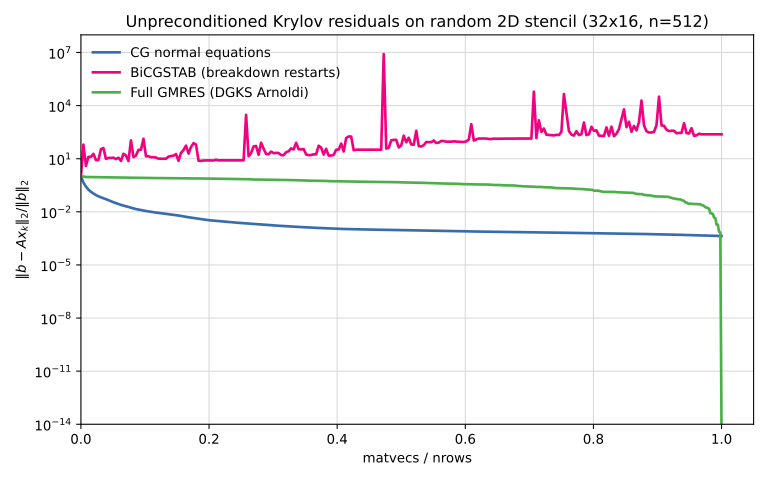
If we decide to store only the matrix \(A \) as well as some intermediate data for the iterative methods, we find that nonsymmetric and indefinite systems simply do not converge in a reasonable amount of time (CGN) or result in explosive memory requirements to achieve convergence at all (restarted GMRES).
Thus some preconditioner is necessary, and the alternatives tested below do not work in the same memory range.
The incomplete LU configurations in this case suffer from singular factors or near-zero pivots. Eventually it works, but only once it has started to consume roughly as much memory as a standard sparse LU factorization. This is especially true once you start accounting for the Krylov subspace you also have to store for restarted GMRES.
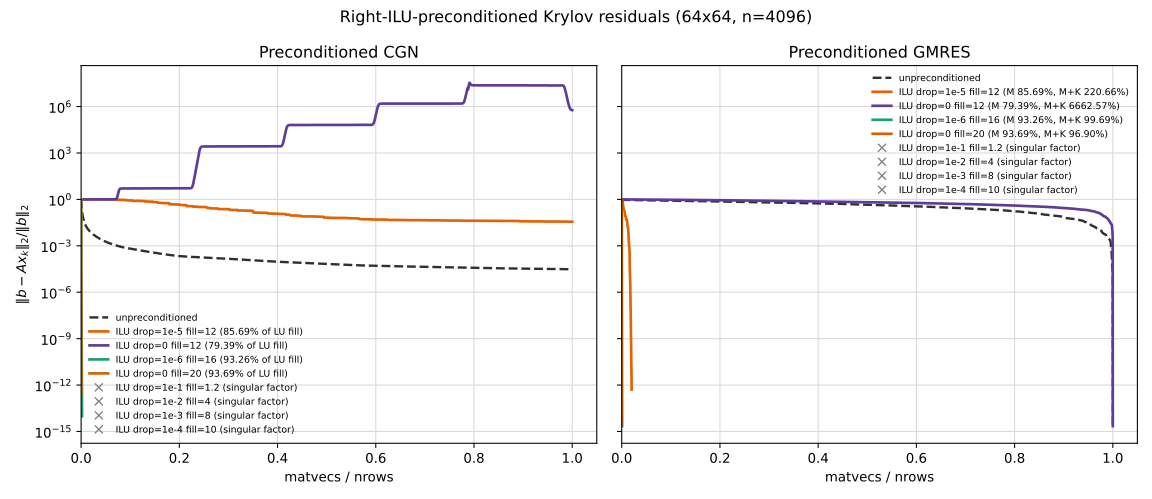
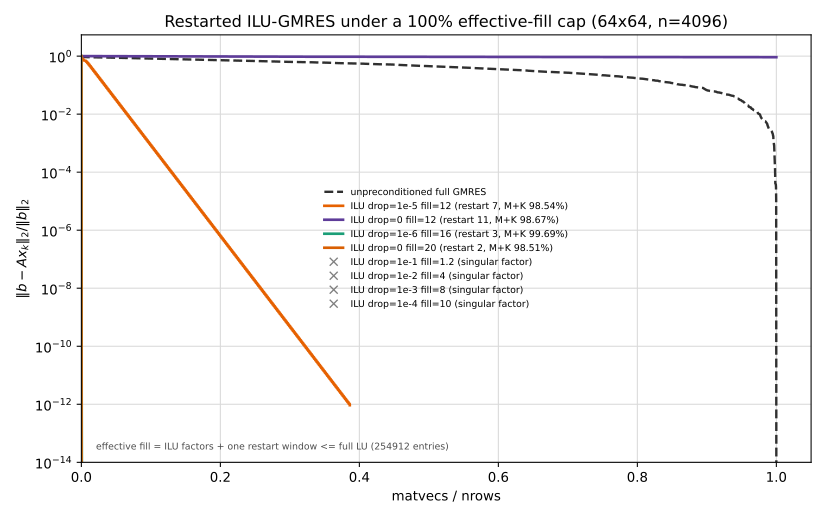
I also show a few ILU parameter settings that “fix” the memory cost at 100% of a sparse LU factorization equivalent.
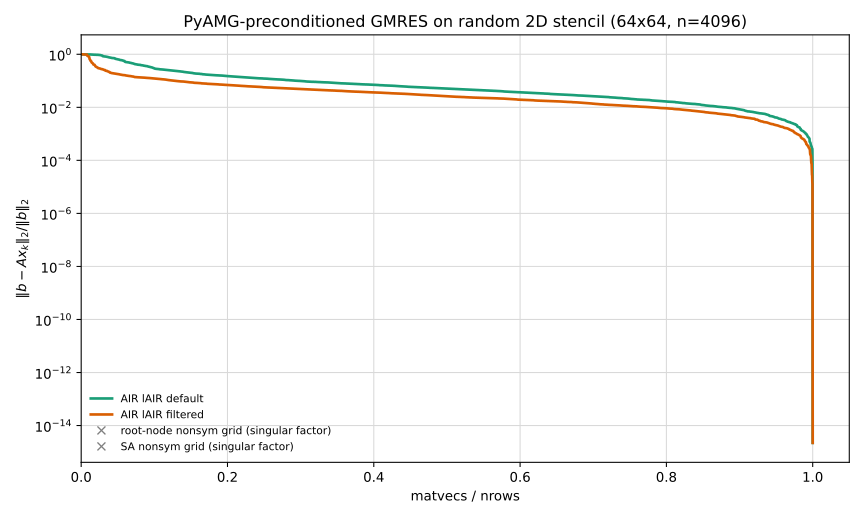
Multigrid is another method that compresses the problem by passing through to “coarse spaces”. Multigrid works best when an invariant subspace has some known compressibility with a “code” that is known in advance. For example the smallest eigenmodes might be very “graph smooth” like in the graph Laplacian case, meaning interpolatory coarsening operators approximate this subspace very well.
For this random nonsymmetric system, the default interpolation heuristics do not find an effective coarse space. Problem-specific multigrid might do better, but that requires structure this example intentionally avoids.
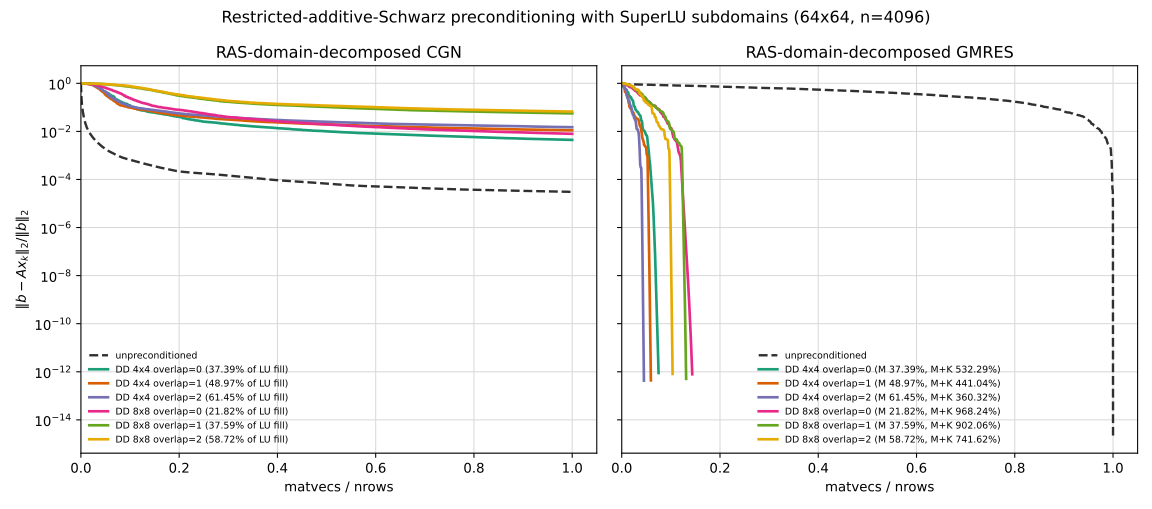
As an alternative to incomplete factorizations or global coarsening, we can partition the problem and solve the subproblems as a preconditioner, discarding off-diagonal interactions as an approximation. However, this faces much the same problem as pure ILU preconditioning: we often get singular local factors which cause the preconditioner to break down, or, once we have found parameters that work on this example, the storage proves little better than simply performing sparse LU.
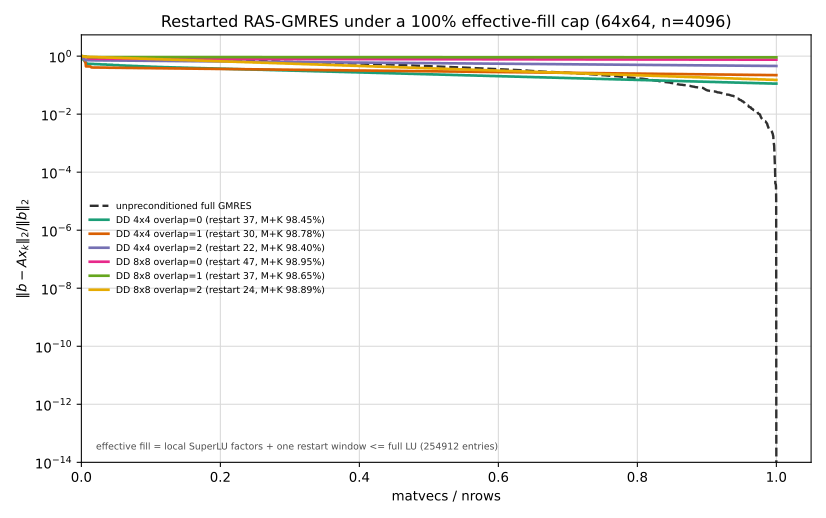
And I do a similar experiment as with ILU: choosing parameters so that our effective bytes utilization is equivalent to a full sparse LU factorization:
The preconditioner I propose here is a quantized left-looking Householder-based QR factorization. Left-looking in this context means that rather than applying the current Householder factor to all future columns, at which point we are “done” with that reflector and don’t need it later in the factorization algorithm, we instead “look left” and apply all reflectors to the current column. The left-looking approach means we need to persist Householder reflectors until the end of the algorithm, but it also means that once we have completed a column of R it is not needed to update future columns. For this quantized approximate factorization, I have found R more sensitive to representation error than the reflectors, in part because errors in a triangular solve can propagate through the dependency chain. It is important that R be consistent with the reflectors actually applied, so a coarsely represented reflector can still be useful if R is computed from that same approximate action. In the left-looking approach we dequantize and apply earlier approximate reflectors while accumulating the current column in working precision, then quantize a completed panel of R only once, without needing to dequantize it except at the solve phase.

Just for reference the dense left-looking Householder algorithm looks as follows in pythonish pseudocode:
def dense_left_looking_householder_qr(A):
    """
    Dense left-looking Householder QR.

    Previous reflectors are applied only when a column is reached. No trailing
    matrix update is pushed eagerly to the right.
    """
    m, n = A.shape
    R = zeros((n, n))
    V = []
    tau = []

    for j in range(n):
        col = A[:, j].copy()

        # Look left: bring column j up to date using earlier reflectors.
        for k in range(j):
            col[k:] = apply_householder_left(V[k], tau[k], col[k:])

        R[:j, j] = col[:j]

        # Factor the active tail. The leading entry of v is implicit 1.
        v_j, tau_j, r_jj = householder(col[j:])
        V.append(v_j)
        tau.append(tau_j)
        R[j, j] = r_jj

    return V, tau, R
This is effectively the dense natural-order factorization. However, for the sparse case we can use a fill-reducing order and an elimination tree, which does two things:
R in parallel)If we further augment this with supernodes, then we can recover dense level-3 BLAS performance characteristics.
I give an overview next of how I did this, but I omit some details and focus on the high-level idea.
The steps for minimizing fill-in and exposing a task graph for a sparse QR factorization are as follows:
Most operations are done in terms of supernodes, which allows us to turn otherwise sparse operations into dense BLAS or LAPACK, but supernodes also significantly compress index information. Otherwise we might have to store a full sparsity pattern for the factors, but supernodes allow us to store structural information only once per supernode and numerical data can be stored contiguously. For “exact” supernodes this results in no additional numerical zeros, but one can relax this to allow some introduction of zeros in exchange for less index storage and better utilization of BLAS and LAPACK. I do not enforce exact supernodal structure here.
| Elimination Tree | Spy Plot | Explanation |
|---|---|---|
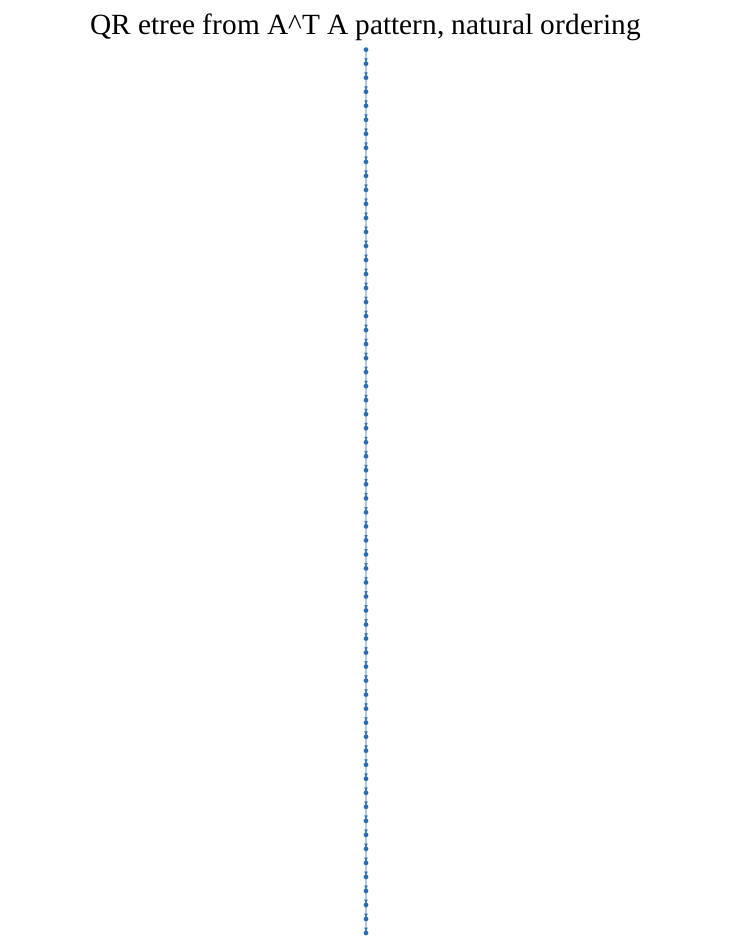 | 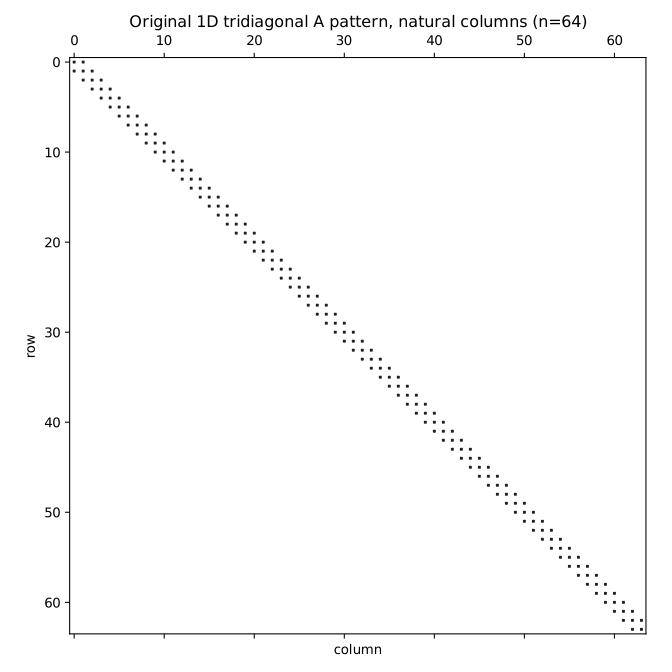 | Original matrix order; etree is just one big chain |
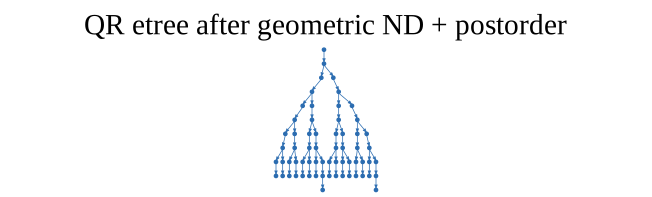 | 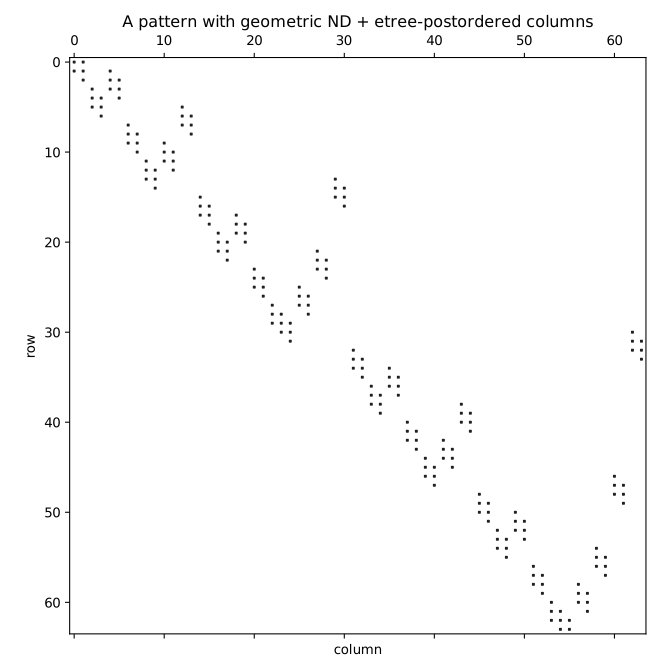 | Nested dissection reordered and postordered |
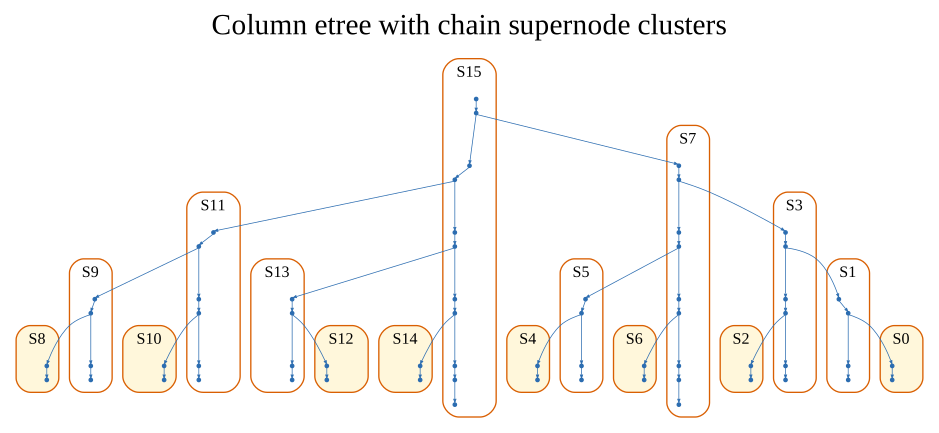 | 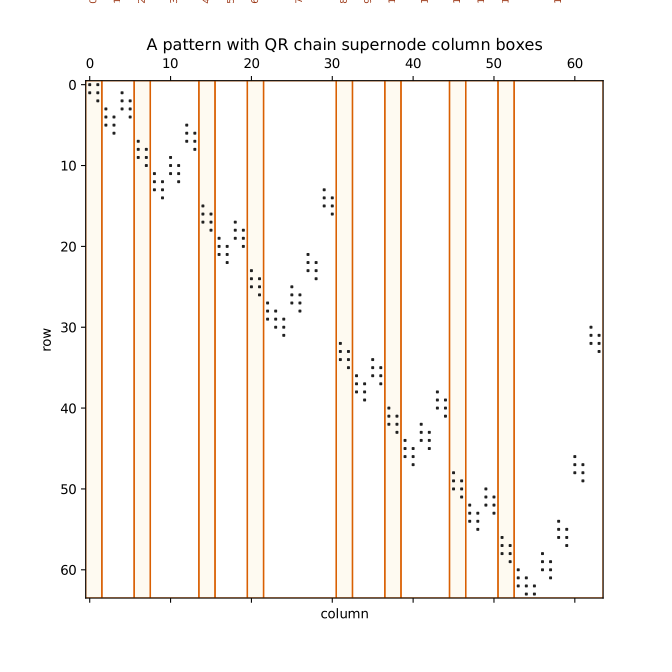 | Supernode detection groups compatible scalar columns |
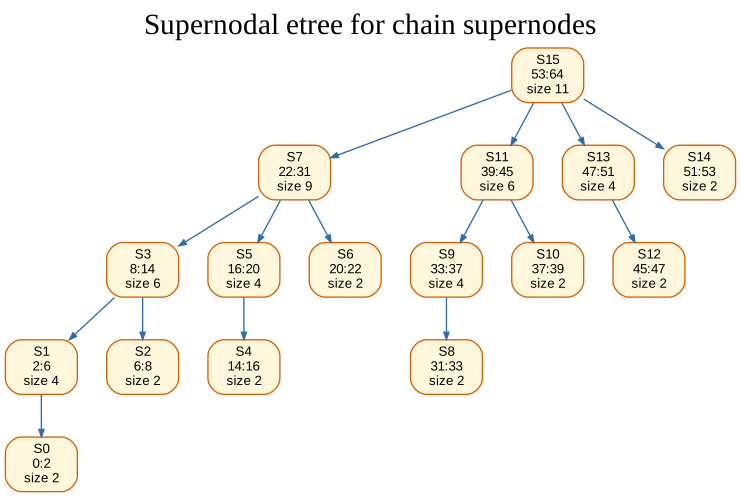 | | Scalar etree contracted into the supernodal etree |
After computing this information, the left-looking factorization looks in pseudocode like below:
def supernodal_left_looking_qr(A, ordering, etree, supernodes, panel_width):
    """
    Sparse left-looking QR after reordering and supernode detection.

    The details of row/column maps are hidden behind gather/scatter helpers.
    """
    A = permute_columns(A, ordering)
    symbolic = build_symbolic_patterns(A, etree, supernodes)
    factor = allocate_factor(symbolic, panel_width)

    for sn in children_before_parent_order(etree):
        rows = symbolic.v_rows(sn)
        cols = supernodes.columns(sn)

        # Gather the dense front for this supernode.
        front = gather_original_entries(A, rows, cols)

        # Look left: apply completed contributors touching this front.
        for prev in symbolic.left_looking_contributors(sn):
            block = gather_factor_block(factor, prev, rows, cols)
            apply_stored_qt(block, front)

        # Factor the supernode in panels to limit dense work size.
        for panel in split_columns(cols, panel_width):
            active_rows = symbolic.active_rows(sn, panel)
            panel_view = front[active_rows, panel]

            V_panel, tau_panel, R_panel = dense_geqrf(panel_view)
            store_householder_panel(factor, sn, panel, active_rows, V_panel, tau_panel)
            store_r_panel(factor, sn, panel, R_panel)

            rest = columns_after(panel, cols)
            apply_panel_qt(V_panel, tau_panel, front[active_rows, rest])

        scatter_front_to_factor(factor, sn, front)

    return factor
For a full-rank matrix, Householder QR does not need numerical pivoting for basic backward stability, so the resulting task graph can be static. Column pivoting can still be necessary for rank revelation, and an approximate factorization can still produce a very small diagonal in R. I take advantage of the static full-rank path in RatchesQR to achieve good CPU utilization even with unbalanced trees and supernode sizes.
In addition to minimizing fill, the reordering done in the symbolic phase also promotes parallelism. Supernodal columns of R can be processed once all of their predecessor columns have been processed (meaning their Householder reflectors are also available). Since each level of the supernodal tree has many independent supernodes, these can be processed in parallel. This parallelism collapses towards the top of the tree, but supernodes become larger, which means parallelism can move into dense linear algebra such as BLAS and LAPACK. To make this transition seamless I use oneTBB in conjunction with TBB-enabled MKL.
I illustrate with the diagram below.
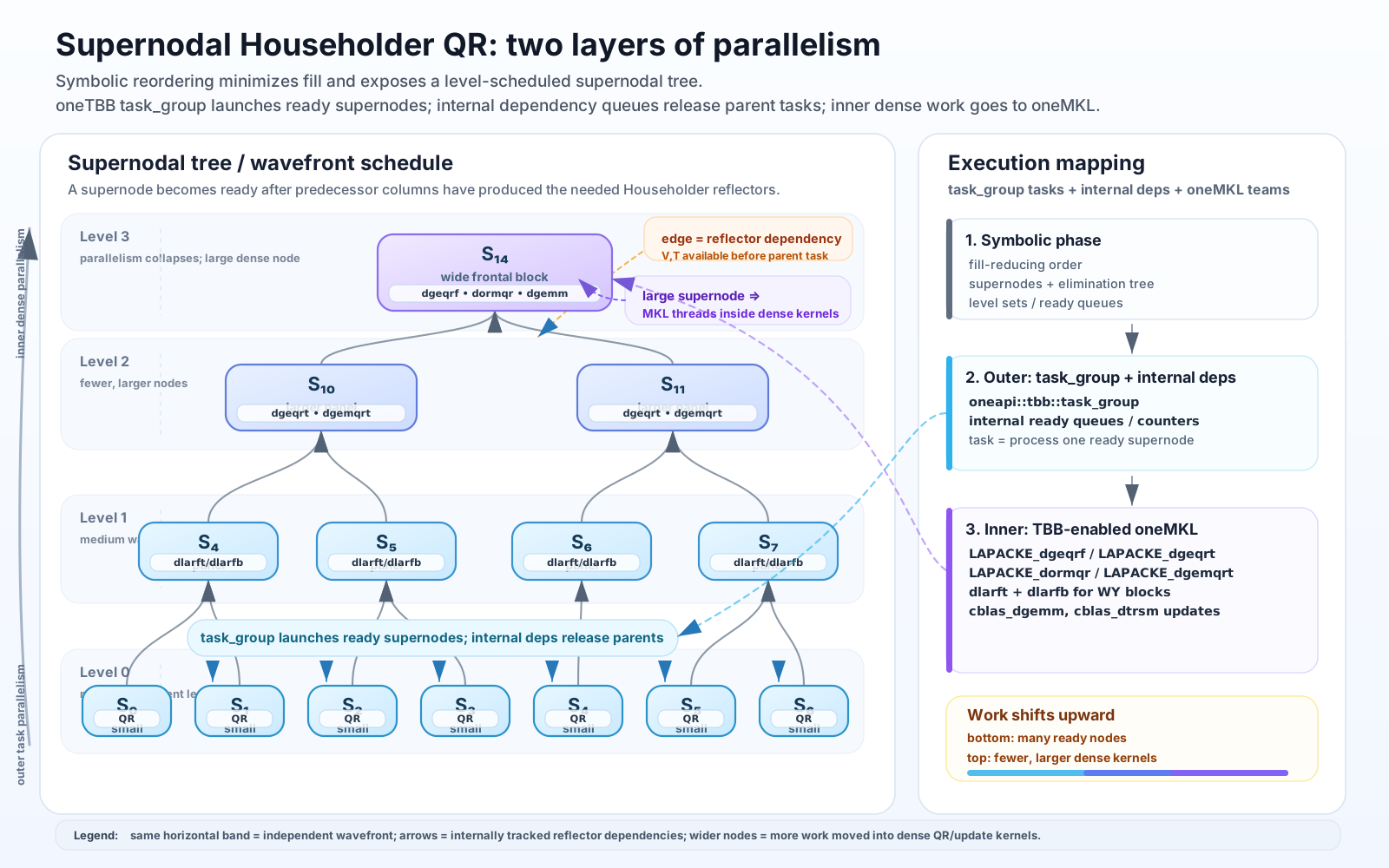
Note that doing triangular solves with R and applications of Q require some different considerations for parallelism, but I omit those details for now; they are readily available in the code.
Some supernodes can be quite large (e.g. separators computed from 3D grids) and use a large amount of memory. I also include a planning phase after symbolic factorization which further subdivides supernodes into panels based on a memory budget provided by the user. This panelization works both for the quantized and unquantized code paths. This essentially sets a limit on the high watermark of memory needed to produce the factorization at the cost of suboptimal dense linear algebra.
The above factorization describes a sparse supernodal QR factorization. We can turn this into a quantized factorization by inserting a dequantize step when gathering a panel and a quantize step when scattering a panel. The trick, however, is dealing with high dynamic range in both the R and the V (householder) factors. This turns out to be achievable.
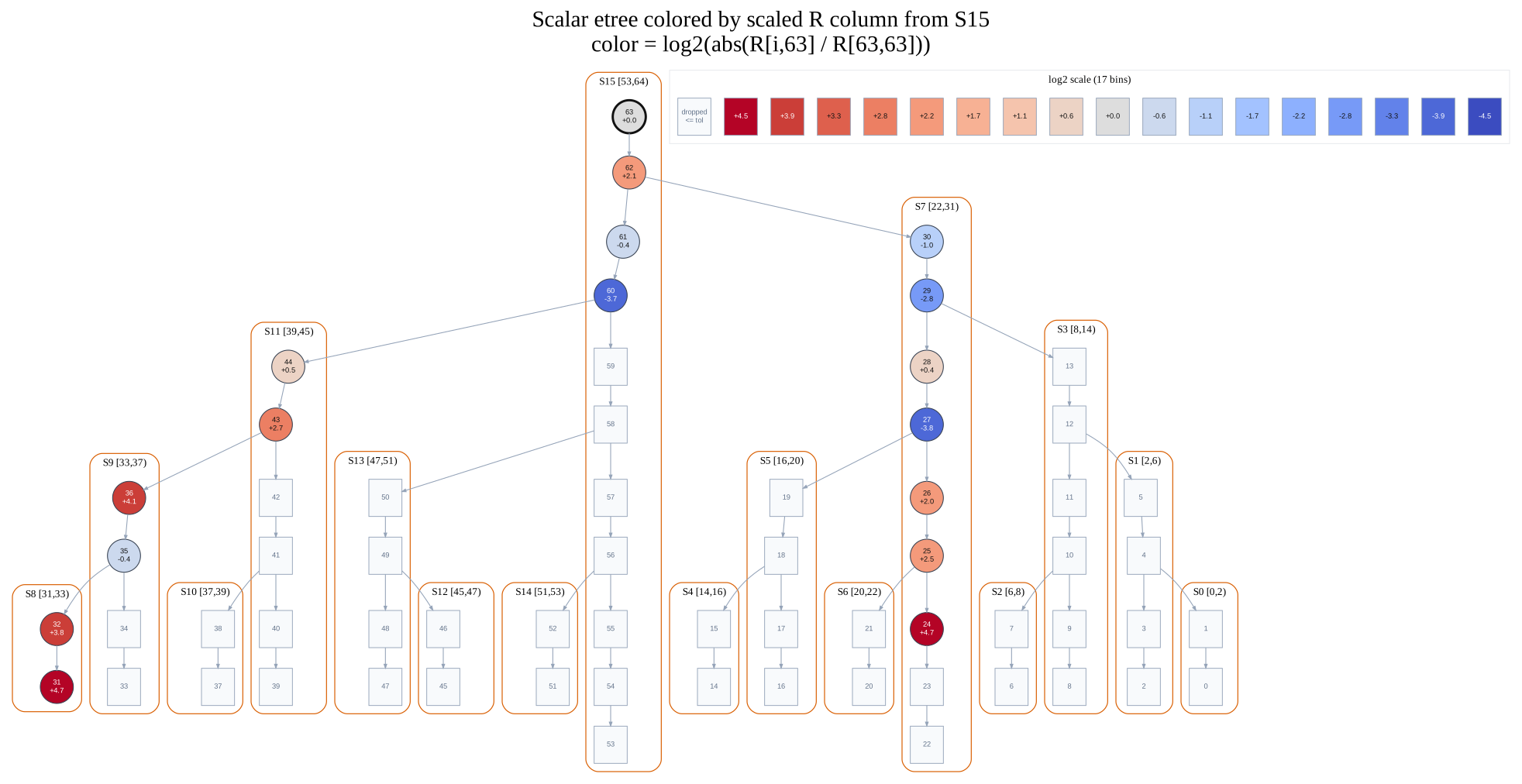
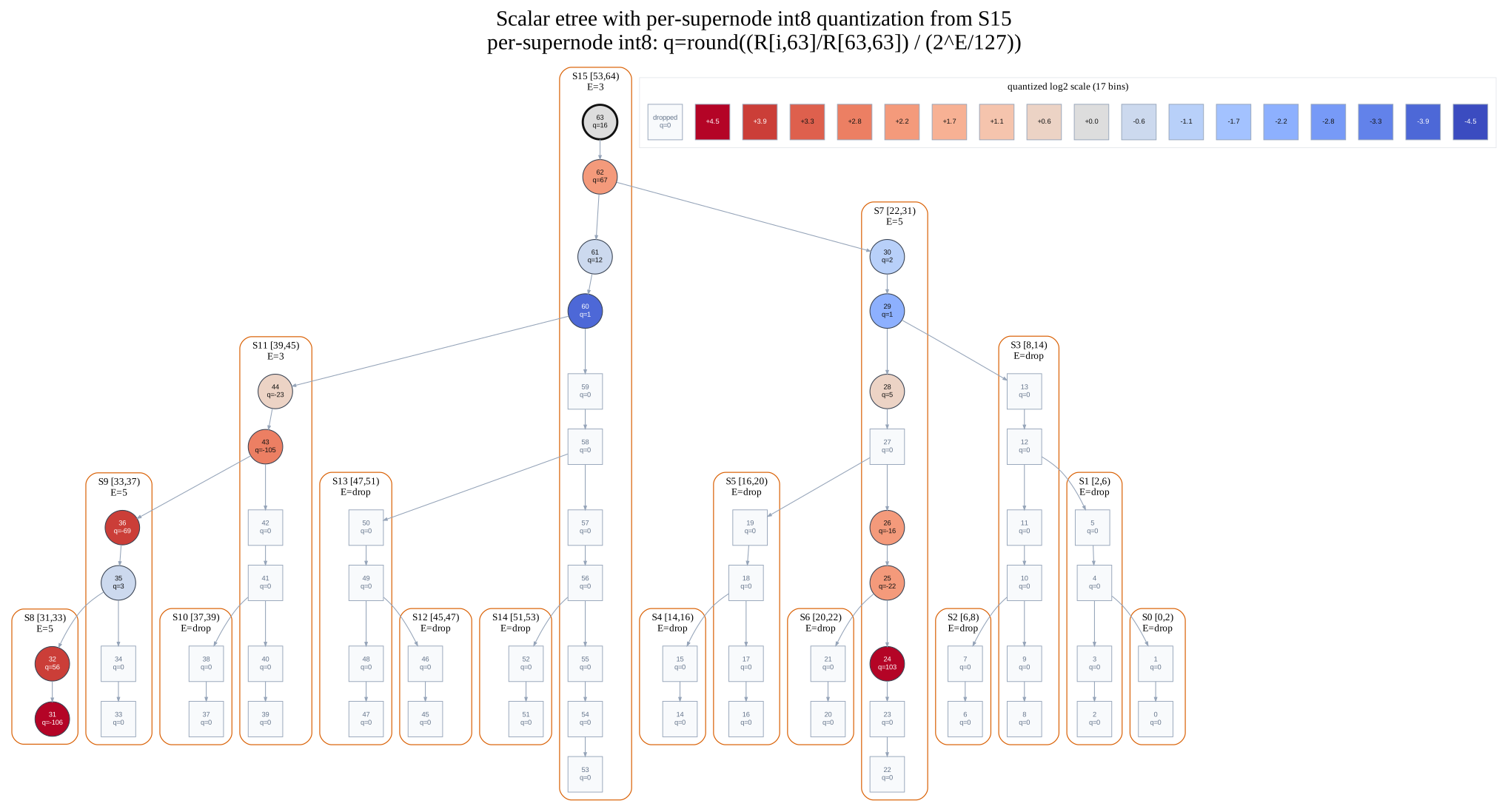
In the left-looking formulation our R factor is less sensitive to accumulation effects because all of its accumulations occur in working precision. However, it can still have a high dynamic range. To balance the need for global connectivity in R (correct accounting for supernodal elimination tree dependencies) while still allowing for some numerical dropping, I segment each column of R by supernode. Each column gets a list of exponents and is quantized separately. This guarantees that the dominant values in every supernode are preserved independently, and the smallest relative values are discarded. The exception here is the diagonal of R, which gets stored in full working precision. Because thresholding also drops entries outside the representable range, I have observed as much as 90x value compression compared with FP64 QR on the same ordering. The end-to-end factor-memory comparison, including metadata, is reported below.
I illustrate a before/after quantization for a single column of R below, using the elimination tree to help visualize the dependence of this column on its predecessor supernodes:
| Before Quantization | After Quantization |
|---|---|
 |  |
While R proves very tolerant of accumulation effects in the left-looking formulation, those effects get moved instead to the Householder factor, which requires a bit more care. I discuss this next.
In the quantized QR factorization, the Householder reflectors are stored in the usual compact form:
\[ H_j = I - \tau_j v_j v_j^T \]
The leading entry of \(v _ j\) is implicit and equal to \(1\), and we only store the sparse tail of \(v_j\).
The hard part is that a single int8 scale for the whole tail can be too crude. The largest entry determines the exponent, and smaller but directionally important entries can round to zero. The supernodal fix for R does not work here because supernodes are calculated based on a column ordering of the input matrix \( A \). If \( A \) is not structurally symmetric these supernodes have no meaning in the row space, which is where the Householder reflectors live.
The naive fix is to store more than one exponent per reflector and attach a flag to every value saying which exponent it uses. That works, but it adds per-entry metadata.
Instead, we use exponent bins.
For each reflector tail, we choose a small number of exponents. In the current useful mode, that number is two:
Each tail entry is assigned to the exponent that gives the lower quantization error. Then we store the entries for each exponent in a separate contiguous bin.
For two bins, the physical layout is:
row_ids:    [ primary rows ... ][ secondary rows ... ]
mantissas:  [ primary vals ... ][ secondary vals ... ]

begin = col_offsets[j]
split = split_offsets[j]
end   = col_offsets[j + 1]

primary bin:   [begin, split)
secondary bin: [split, end)
The metadata per reflector is just:
No per-entry exponent flags are needed, and we can merge-iterate the bins. This gives us the main benefit of multiple scales without paying for per-value exponent tags. For two-scale V, the numerical values are still int8, but small reflector entries no longer have to compete directly with the largest entry for the same exponent. That helps preserve the reflector direction, and therefore the action represented by Q, while keeping the value storage compact.
I’m still on the fence about this merge-iterable approach to segmenting \( V \) versus a bitset-of-flags approach. Neither option maps to an ideal computational pattern. Merge iteration can become expensive as the number of exponents grows beyond 2 here, but with bitset flags we add additional storage for every element and have to contend with alignment issues if we pack it to save space. It also entails a branch for every value, but this is possibly the lesser consideration because we generally are just streaming values out to be dequantized.
It is usually not common to left+right precondition a nonsymmetric linear system. Left and right preconditioning is often employed to retain symmetry; for example, one could do \( L^{-T} A L^{-1} \) for a symmetric matrix \( A \) and incomplete Cholesky factor \(L\).
In the specific case of a QR-based preconditioner, though, it appears advantageous in these experiments to solve the two-sided transformed system \(Q^T A R^{-1}y=Q^T b\), followed by \(x=R^{-1}y\), rather than use only the right-preconditioned system \(A R^{-1}y=b\). The simple explanation is that if
\[ A \approx QR \]
then the left+right preconditioned system is “almost symmetric” because
\[ Q^T AR^{-1} \approx Q^T Q \]
Here Q is reconstructed from the quantized reflectors and is not exactly orthogonal, so the right-hand side is not exactly the identity.
More specifically, the transformed matrix is close to the identity, which gives both spectral clustering and approximate normality. This is a much better situation for GMRES.
Here I compare a hyperparameter sweep for incomplete-LU-preconditioned GMRES against the int8-quantized QR preconditioner on a 3D stencil-shaped nonsymmetric system generated as follows:
import numpy as np
import scipy.sparse as sp
rng = np.random.default_rng(0)
mx=32
my=32
mz=32
m=mx*my*mz
bands = [-mx*my,-mx,-1,0,1,mx,mx*my] # 3D stencil-shaped bands
A = sp.diags([rng.uniform(-1,1,size=m) for _ in bands],bands,shape=(m,m))
As in the 2D example, a literal Cartesian stencil requires masking the wraparound entries on the +/-1 and +/-mx diagonals. The results below are for the matrix actually generated by the code, including those band connections.
I share a quick summary table before diving deep into the full parameter exploration.
| comparison | QR memory advantage |
|---|---|
| vs SuperLU, factor values | 7.50× smaller |
| vs SuperLU, concrete factor storage | 10.87× smaller |
| vs SuperLU, values + Krylov | 5.25× smaller |
| vs converged ILU MMD fill=80/160 drop=1e-4, factor values | 3.17× smaller |
| vs converged ILU MMD fill=80/160 drop=1e-4, concrete factor storage | 4.61× smaller |
| vs converged ILU MMD fill=80/160 drop=1e-4, values + Krylov | 2.52× smaller |
| vs converged ILU MMD fill=80/160 drop=1e-6, values + Krylov | 2.52× smaller |
The table shows a sharp robustness/memory tradeoff. SuperLU reaches a residual of 5.57e-12 with 283.35 MiB of factor values and 425.52 MiB of concrete factor storage. The two-scale Q8/R8 preconditioner reaches 9.91e-09 with 37.77 MiB of factor values, or 54.02 MiB including Krylov storage. This is 7.5x less factor-value memory than SuperLU while still reaching the requested tolerance.
The ILU results are more brittle. Small and moderate fills fail across the tested drop tolerances, often with exploding residuals, NaN, or immediate stagnation. ILU first converges at MMD fill=80 with drop=1e-4, using about 120 MiB of factor values. These convergent ILU configurations are stronger per iteration, but use about 3.18x more factor-value memory than QR.
| method/config | status | residual | iters | factor values MiB | factor concrete MiB | Krylov MiB | values+Krylov MiB |
|---|---|---|---|---|---|---|---|
| QR two-scale Q8/R8 | converged | 9.91e-09 | 319 | 37.77 | 39.15 | 16.25 | 54.02 |
| SuperLU full LU | direct | 5.57e-12 | 1 | 283.35 | 425.52 | 0.00 | 283.35 |
| ILU fill=2 drop=1e-5 | failed | 2.06e+12 | 15 | 3.15 | 5.22 | 16.25 | 19.40 |
| ILU fill=2 drop=1e-6 | failed | 9.93e+17 | 10 | 3.15 | 5.22 | 16.25 | 19.40 |
| ILU fill=2 drop=1e-8 | failed | 1.58e+09 | 28 | 3.15 | 5.23 | 16.25 | 19.40 |
| ILU fill=2 drop=1e-3 | failed | 1.56e+20 | 13 | 3.15 | 5.23 | 16.25 | 19.40 |
| ILU fill=2 drop=1e-4 | failed | 2.10e+19 | 17 | 3.15 | 5.23 | 16.25 | 19.40 |
| ILU fill=2 drop=1e-2 | failed | 2.62e+15 | 11 | 3.15 | 5.23 | 16.25 | 19.40 |
| ILU fill=5 drop=1e-6 | failed | 1.46e+16 | 25 | 7.59 | 11.89 | 16.25 | 23.84 |
| ILU fill=5 drop=1e-3 | failed | 7.44e+16 | 9 | 7.59 | 11.89 | 16.25 | 23.84 |
| ILU fill=5 drop=1e-8 | failed | 3.26e+23 | 5 | 7.59 | 11.89 | 16.25 | 23.84 |
| ILU fill=5 drop=1e-4 | failed | 1.65e+09 | 12 | 7.59 | 11.89 | 16.25 | 23.84 |
| ILU fill=5 drop=1e-5 | failed | 1.00e+00 | 1 | 7.60 | 11.89 | 16.25 | 23.85 |
| ILU fill=5 drop=1e-2 | failed | 1.00e+00 | 1 | 7.60 | 11.89 | 16.25 | 23.85 |
| ILU fill=10 drop=1e-5 | failed | nan | 128 | 15.37 | 23.55 | 16.25 | 31.62 |
| ILU fill=10 drop=1e-4 | failed | 1.00e+00 | 1 | 15.37 | 23.56 | 16.25 | 31.62 |
| ILU fill=10 drop=1e-3 | failed | 1.00e+00 | 1 | 15.38 | 23.57 | 16.25 | 31.63 |
| ILU fill=10 drop=1e-2 | failed | 1.00e+00 | 1 | 15.38 | 23.57 | 16.25 | 31.63 |
| ILU MMD fill=20 drop=1e-6 | failed | 1.00e+00 | 1 | 32.65 | 49.47 | 16.25 | 48.90 |
| ILU MMD fill=20 drop=1e-4 | failed | 1.00e+00 | 1 | 32.65 | 49.47 | 16.25 | 48.90 |
| ILU MMD fill=20 drop=1e-2 | failed | 1.00e+00 | 1 | 32.65 | 49.48 | 16.25 | 48.90 |
| ILU MMD default-pivot fill=20 drop=1e-2 | failed | 1.00e+00 | 1 | 32.66 | 49.49 | 16.25 | 48.91 |
| ILU MMD fill=40 drop=1e-6 | failed | 1.00e+00 | 1 | 64.98 | 97.97 | 16.25 | 81.23 |
| ILU MMD fill=40 drop=1e-2 | failed | 1.23e+07 | 65 | 64.98 | 97.97 | 16.25 | 81.23 |
| ILU MMD fill=40 drop=1e-4 | failed | 1.00e+00 | 1 | 64.98 | 97.97 | 16.25 | 81.23 |
| ILU MMD fill=80 drop=1e-2 | failed | 6.55e+01 | 128 | 117.11 | 176.17 | 16.25 | 133.36 |
| ILU MMD fill=160 drop=1e-2 | failed | 6.55e+01 | 128 | 117.11 | 176.17 | 16.25 | 133.36 |
| ILU MMD fill=80 drop=1e-4 | converged | 6.42e-09 | 17 | 119.89 | 180.33 | 16.25 | 136.14 |
| ILU MMD fill=160 drop=1e-4 | converged | 6.42e-09 | 17 | 119.89 | 180.33 | 16.25 | 136.14 |
| ILU MMD fill=80 drop=1e-6 | converged | 2.39e-10 | 4 | 120.03 | 180.54 | 16.25 | 136.28 |
| ILU MMD fill=160 drop=1e-6 | converged | 2.39e-10 | 4 | 120.03 | 180.54 | 16.25 | 136.28 |
| ILU COLAMD pivot=0.1 fill=20/40/80 | factor failed | singular | n/a | n/a | n/a | n/a | n/a |
The important result is not just that QR converges, but that it converges in the memory regime where ILU fails. At fill=20, ILU uses about the same memory as QR and fails. At fill=40 it uses more memory and still fails. It first converges once the factor reaches about 120 MiB, putting it in a different memory class from the QR preconditioner.
The above is a preview of a preconditioner concept, and the code remains untuned. While it does parallelize reasonably well, I have observed some loss of scalability on higher-core-count systems which I’m still debugging. Furthermore, this is based on a sparse QR factorization, so its column symbolic analysis uses the graph of \( A^T A \) (normally without forming the numerical product) rather than an ordering graph such as \( A + A^T \) commonly used for LU. This produces larger supernodes, though numerical pivoting can erode LU’s structural advantage.
All this is to say that the preconditioner achieves the byte-efficiency target on this test, but moves work from persistent factor storage into dense linear algebra and quantization/dequantization. This post establishes the storage result; setup and solve performance are the next things to measure. For compute-heavy environments such as GPUs, this may be a very favorable tradeoff.