As I have increased my usage of AI agents in developing new sparse linear solver algorithms, I have run into the problem of AI agents “faking” benchmark results by using different clocks, changing the “rules” of a benchmark (making them easier), and producing results that are not apples-to-apples comparable. After burning a huge amount of tokens, it is frustrating to finally control for all of these small variations and find that all apparent speedups were illusory. A simple approach to keep a large number of agents “on track” solving the same problem is to construct a judge process that manages the benchmark challenge:
A and right-hand-side bAx=b and sends x to judgeThis is a perfectly workable solution, and since all agents can work from the same judge I can be confident they are all following the same rules and therefore I can try a larger volume of research ideas in parallel. However, it does not scale very well with a growing number of participants and growing problem sizes (which could reach billions of rows). We can avoid network bandwidth for A and b by basing those on publicly known generators and transmitting only generator parameters. Before solving, however, x is unknown to both the judge and the participant, so under the naive scheme the participant must transmit x in some form for the judge to compute the backward error and validate that the system has indeed been solved.
I propose here a way for the participant to compute a backward error themselves and give anyone else a short proof that the committed solution meets the accuracy target. The certificate grows like \(O(\sqrt{m})\) for an \(m\)-row matrix, and any validator can check it without receiving the solution vector.
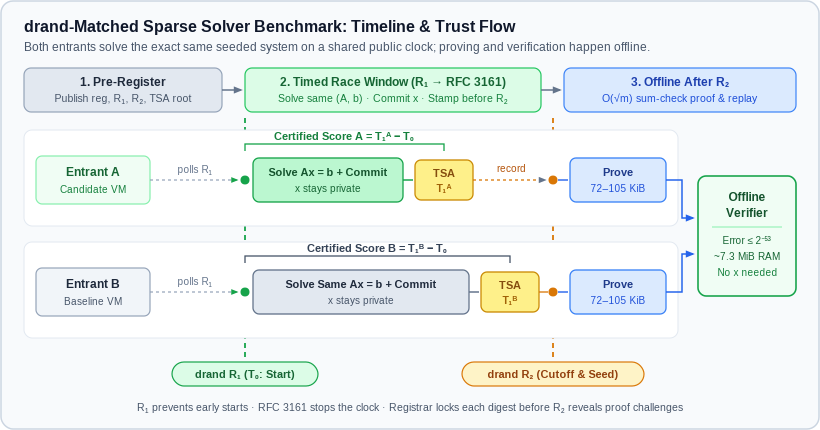
Two public services supply the clock. A drand Quicknet round supplies the scheduled start and the randomness for the matrix. An RFC 3161 time-stamp authority signs the commitment time. The numerical proof can then be checked offline.
I now give a rough overview of how the proof works; for the details, this repository has a reference C implementation.
The competition profile (signed-three-band-backward80-v2) generates a seeded symmetric-indefinite sparse matrix \(A\) of dimension \(n = 2^\ell\) with \(7n - 12\) nonzeros: a diagonal plus three off-diagonal bands per row centered at offsets \(1\), \(n^{1/3}\), and \(n^{2/3}\). Every nonzero entry of \(A\) is \(+1\) or \(-1\), and each right-hand-side entry is \(b_i = \pm 1/n\). Because the matrix is indefinite with \(\pm 1\) entries, direct elimination hits frequent exact \(1 - 1 = 0\) cancellations, so reaching machine-precision backward error requires pivoting or shifting plus iterative refinement. Matrix generator
The sequence of a timed proof roughly looks like this:
Locking the commitment before the second drand round lets the slower proving step run offline after the timer stops.
The Fiat–Shamir transform lets the prover and an offline validator derive the same challenges by hashing the authenticated beacon and successive proof messages. A passing transcript certifies a joint 2-norm backward-error upper bound of at most \(2^{-53}\) for the encoded solution. This relies on the beacon, timestamp, and commitment assumptions. The reference documents which parts of the soundness analysis carry over to the public-beacon setting. Soundness assumptions
On the larger systems, proving and validating each took a small fraction of the solve time while keeping verifier memory flat and proofs orders of magnitude smaller than the raw binary64 solution vector. Here is one passing candidate draw at each size on an eight-core Google Cloud t2d-standard-8 (proving and verifying exclude the wait for the second beacon; proof bytes include the variable-length RFC 3161 response). Per-draw measurements
| Rows | Solve (s) | Commit (s) | Prove (s) | Verify (s) | Verifier peak (MiB) | Solution bytes | Proof bytes | Compression |
|---|---|---|---|---|---|---|---|---|
| 4,096 | 0.050 | 0.022 | 0.040 | 0.039 | 7.08 | 32,768 | 9,316 | 3.52× |
| 262,144 | 13.292 | 0.458 | 1.093 | 1.251 | 7.22 | 2,097,152 | 38,754 | 54.11× |
| 1,048,576 | 56.286 | 1.598 | 4.292 | 4.854 | 7.46 | 8,388,608 | 71,779 | 116.87× |
| 2,097,152 | 207.079 | 3.147 | 8.577 | 9.601 | 7.26 | 16,777,216 | 104,675 | 160.28× |
At 4,096 rows, verification takes nearly as long as solving. At 2,097,152 rows, checking the 104.7 KiB proof takes 9.6 s and 7.3 MiB of RAM for a 16.8 MiB solution that took over 200 s and tens of gigabytes to compute.
The reference repository provides a single stencil binary (plus a libstencil.so C library) that handles matrix generation, commitments, RFC 3161 timestamp queries, proving, and offline verification. To verify Quicknet BLS signatures in a public drand match, build stencil against blst:
git clone https://github.com/ReidAtcheson/sparse-solver-challenge.git
cd sparse-solver-challenge
make BLST_DIR=/path/to/blst
The solver itself needs no cryptography code. It reads the problem from start via libstencil.so (stencil_instance_open and stencil_rows), solves \(Ax = b\), and either writes the private binary64 vector x.f64 or passes it in memory to libstencil to commit.
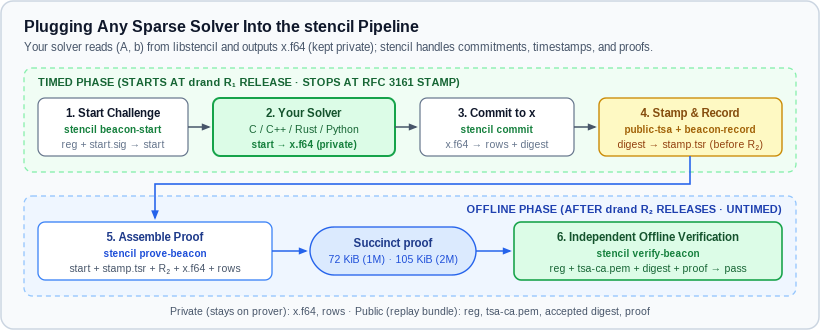
A synchronized drand match runs in four steps (see BEACON.md for the full script and local practice mode):
# 1. Before START_ROUND: organizer publishes a registration for each entrant
./stencil beacon-register 1048576 team-a nonce32 "$START_ROUND" "$PROOF_ROUND" "$ERROR_NS" reg

# 2. When START_ROUND arrives: fetch its 48-byte Quicknet signature, solve, and commit
./stencil beacon-start reg start.sig start
./my-solver reg start x.f64                        # replace with any solver
./stencil commit reg start x.f64 rows digest

# 3. Stop the clock via Sigstore (or FreeTSA) and submit to the registrar before PROOF_ROUND
./examples/public-tsa sigstore stamp-commit reg start digest stamp.tsr
./stencil beacon-record reg tsa-ca.pem "$POLICY_OID" start digest stamp.tsr ledger

# 4. After PROOF_ROUND arrives: build the proof and verify it offline anywhere
./stencil prove-beacon reg tsa-ca.pem "$POLICY_OID" start digest stamp.tsr proof-round.sig x.f64 rows proof
./stencil verify-beacon reg tsa-ca.pem "$POLICY_OID" "$WINNING_DIGEST_FILE" proof
One practical application of this format is as a contract for autonomous AI research agents. Because the proof is just a binary transcript certifying accuracy and timing, there is no benchmark code for an agent to trace, edit, or game. At a high level it acts like a type that the agent must compute a witness for, and producing the witness automatically yields comparable benchmark data.
I tested this with two agents, Astra 6.2 Ultra and Gemini 4 Neon High, on t2d-standard-8 VMs (8 AMD Zen 3 cores, 32 GiB RAM). Both received the same brief: build an in-memory solver that beats tuned Intel oneMKL Pardiso across five matched 1,048,576-row (\(2^{20}\)) live drand rounds without exceeding oneMKL Pardiso’s peak memory or 2× its backward error, and push up to 2,097,152 rows (\(2^{21}\)).
Each agent ran its own five matched \(2^{20}\) draws against its own tuned oneMKL Pardiso baseline on the official drand → RFC 3161 clock:
| Agent run | Candidate | Paired oneMKL Pardiso | Paired speedup | Peak RSS (vs. oneMKL Pardiso) | backward_2_upper |
|---|---|---|---|---|---|
| Astra 6.2 Ultra (MUMPS + custom ordering)* | 77 s | 139 s | 1.84× | ~11.0 GiB (−27–31%) | 2.97–3.06e−17 |
Gemini 4 Neon High (custom C++20 int16_t MF) | 49 s | 98 s | 2.00× | 5.8 GiB (−63%; vs. 15.8 GiB) | 4.68–4.89e−17 |
*Astra’s race used a 15 s post-release launch buffer for both solvers (solver-only median speedup was 2.08×). Times and speedups are medians across each agent’s five matched draws.
At 2,097,152 rows (\(2^{21}\)), oneMKL Pardiso ran out of memory on the 32 GiB VM, while both agents passed. Gemini 4 Neon High finished a live drand round in 167 s using 14.3 GiB peak RSS (less than oneMKL Pardiso used at half the size), and Astra 6.2 Ultra certified three draws using 26.9 GiB peak RSS.
The two agents chose very different algorithms:
~3.0e−17).SGEMM) that stores \(L\) as per-column scaled int16_t and recovers \(2^{-53}\) accuracy via right-preconditioned GMRES, with ~63% less peak memory than oneMKL Pardiso.The full research prompts, per-draw tables, downloadable evidence archives, and unedited agent solver descriptions are preserved in Appendix A: Astra 6.2 Ultra and Appendix B: Gemini 4 Neon High.
Another interesting application is to set ahead of time a specific subset of future drand rounds (for example, by publishing them on a website). Anyone can observe these rounds, poll until a round becomes available, and attempt the resulting sparse linear system. The advantage is that everyone who attempts those public rounds solves the exact same system and is timed on the same clock.
Timing jitter still matters: in our live runs, drand relay fetches occasionally added 11–20 s even on cloud VMs, which is why Astra’s race used a 15-second launch buffer. For a public leaderboard, picking a large enough system makes network and regional jitter negligible relative to solve time.
This proof format lets many participants solve the same problems on the same clock while keeping transcripts small enough to archive or put on a public leaderboard. For autonomous research agents, it enforces apples-to-apples accuracy and timing without constraining language, algorithm, or libraries. Hardware and memory limits still have to be enforced outside the proof when comparing algorithms rather than raw wall-clock speed, but otherwise agents are free to try whatever solves the system fastest.
The appendices below preserve the full research assignments, per-draw benchmark tables, evidence links, and agent-written solver descriptions from the two autonomous runs summarized above.
Develop an in-memory solver for the signed symmetric-indefinite systems in the Sparse Solver Challenge. Find the largest system you can certify on a Google Cloud
t2d-standard-8with eight cores and 32 GiB of RAM. Compare against a tuned Intel oneMKL PARDISO baseline. On every draw PARDISO solves, your candidate must solve the same matrix and right-hand side using at most PARDISO’s peak memory and at most twice its backward error. You may use any algorithm, language, or existing library.Tune on separate draws, freeze the configurations, and test increasing powers of two using fresh drand seeds. For the head-to-head test, preregister five 1,048,576-row draws with future start and proof rounds spaced far enough apart for both entrants to finish. Run each entrant and its prover on a dedicated, identically configured VM. Check that the input hashes agree. Score the race from drand release to the RFC 3161 stamp and also measure solver-only time, peak RSS, and certified accuracy. Report every draw and every failure.
Give each solver the same 30 GiB memory allowance with swap disabled. Use auto-deleting disks, impose a 24-hour VM lifetime, and stay within the authorized cloud budget. Preserve the source, build instructions, and replayable certificates locally. Verify the proofs, describe the certification workflow, and remove the cloud resources when finished.
In the capacity experiment, the two solvers took turns on one VM. The table gives successful solver-only wall times, with ranges across separate seeded draws. The fastest candidate at the largest certified size used a band-aware ordering, single-precision MUMPS factors, and GMRES refinement with residuals evaluated in higher precision. A binary64 Schur-complement variant also certified a draw at that size. Capacity measurements and pairwise error bounds
| Rows | Candidate passes / draws | PARDISO passes / draws | Candidate solve (s) | PARDISO solve (s) |
|---|---|---|---|---|
| 4,096 | 1/1 | 1/1 | 0.050 | 0.045 |
| 262,144 | 1/1 | 1/1 | 13.29 | 9.62 |
| 1,048,576 | 3/3 | 3/3 | 56.29–73.54 | 107.38–112.78 |
| 2,097,152 | 3/4 | 0/4 | 207.08–648.94 | — |
| 4,194,304 | 0/2 | 0/2 | — | — |
| 8,388,608 | 0/1 | 0/1 | — | — |
At 1,048,576 rows, the median paired speedup was 1.50×. PARDISO was faster on both smaller tests. Across all five matrices PARDISO solved, the candidate used less peak memory, and its backward error was at most 0.653 times PARDISO’s. At 2,097,152 rows, PARDISO reported insufficient memory on every draw. At 4,194,304 rows, one candidate hit the memory ceiling and the other was stopped during refinement to free the VM for the next draw; the 8,388,608-row attempt was stopped at the end of the experiment while still running.
The frozen tree-parallel MUMPS candidate and oneMKL PARDISO ran on five fresh 1,048,576-row systems, with each entrant solving and proving on its own identically configured eight-core VM. Sigstore timestamped the manifest for all ten attempts at 12:59:27 UTC, before the first draw at 13:18 UTC. The five start rounds were seven minutes apart, with each proof round five minutes after its start. Both machines targeted a solver launch 15 seconds after release, and their input hashes matched on every draw.
| drand start round | drand proof round | Candidate release-to-stamp (s) | PARDISO release-to-stamp (s) | Speedup |
|---|---|---|---|---|
| 34183372 | 34183472 | 72 | 136 | 1.89× |
| 34183512 | 34183612 | 77 | 139 | 1.81× |
| 34183652 | 34183752 | 69 | 140 | 2.03× |
| 34183792 | 34183892 | 77 | 142 | 1.84× |
| 34183932 | 34184032 | 82 | 137 | 1.67× |
The median paired speedup on the drand-to-RFC-3161 clock was 1.84×; on the separately measured solver-only clock (excluding the 15-second launch buffer and commit/stamp overhead) it was 2.08×. The candidate used 27–31% less peak memory on the same matrices, and its backward error was at most 0.644 times PARDISO’s on each draw. A separate registrar accepted all ten commitments before their deadlines, and all ten numerical certificates passed offline replay. The archive includes the timestamped schedule, accepted digests, proofs, host measurements, and replay instructions. Download the five-draw evidence archive
For all five races at 1,048,576 rows, I wrote the ordering and refinement code around MUMPS. The ordering uses the three-band structure to limit fill-in during elimination. At each level it tries three ways to bisect the matrix graph, using the row index and its position within the long-band spacing. For each cut, a bipartite matching identifies the smallest set of vertices that touches every crossing edge. I keep the cut with the smallest such set and order those vertices last, so the two interiors can be eliminated independently.
MUMPS computes a pivoted symmetric-indefinite factorization in single precision and keeps the factors in RAM. Single precision halves the storage for each numerical factor entry. I reuse those factors to correct a double-precision solution, recomputing the residual b − Ax against the original matrix in extended precision. The million-row build uses generalized conjugate residual (GCR) refinement. A final sweep adjusts individual solution entries when the rounded change reduces the residual norm. The smaller capacity runs used sequential MUMPS with threaded dense kernels. The million-row build used OpenMP to process independent branches of the elimination tree, with Intel oneMKL supplying the dense kernels.
At 2,097,152 rows, the original GCR build exhausted its refinement budget on the first draw. For two later draws I kept the same factorization strategy and used GMRES for the correction equations, storing its search directions in single precision. On the 207.08-second draw, seven cycles of five steps each brought the estimated backward error to 4.70e−17. After the final sweep, the independent verifier certified an upper bound of 2.942e−17.
The 648.94-second result at that size came from a different solver. It split the matrix into two roughly million-row interiors joined by 12,124 interface variables, eliminated each interior in double precision, and solved the resulting dense Schur complement on the interface. Recomputing interior factors during back-substitution kept only one interior’s factors resident at a time. The larger, uncertified attempts extended this approach with recursive splits at four million rows and an eight-slab partition at eight million rows.
Spin up a non-persistent Google Cloud
t2d-standard-8(8 cores, 32 GiB RAM, 300 GB auto-deleting disk, 24-hour maximum lifetime, no snapshots or persistent resources) and participate in the Sparse Solver Challenge. Build a fully in-memory sparse solver in C, C++, or Rust (zero disk usage inside the solver library) to solve systems up to two million rows (\(2^{21}\)) and beat Intel oneMKL PARDISO. Tune PARDISO as well so the comparison is best-versus-best. On every system PARDISO can solve, your solver must use no more peak memory than PARDISO and achieve a certified backward error within a factor of two of PARDISO’s.For the final certified comparison, provision two identically configured
t2d-standard-8hosts and run five matched live drand Quicknet rounds at 1,048,576 rows (\(2^{20}\)), spaced far enough apart that both solvers solve the exact same system per round and produce independently verifiable transcripts. Measure performance on the officialdrand → RFC 3161clock of the proof transcript (alongside solve wall time, peak RSS, and certified backward error), verify all transcripts, and remove all cloud resources when finished.
The frozen custom C++20 solver (spsolve-v6-int16) and the fastest passing oneMKL PARDISO configuration (mkl-pardiso-gomp) ran simultaneously on two identically configured t2d-standard-8 VMs across five preregistered 1,048,576-row drand Quicknet rounds spaced four minutes apart (195-second commit window per draw, Sigstore Public Good RFC 3161 TSA with ±1 s uncertainty). Both hosts derived identical 80-byte registration prefixes (reg[:80] of the 144-byte registration) and 32-byte instance seeds on every draw, and all ten transcripts passed offline verify-beacon replay.
| drand start round | drand proof round | Candidate release-to-stamp (s) | PARDISO release-to-stamp (s) | Speedup | Candidate peak RSS (MiB) | PARDISO peak RSS (MiB) |
|---|---|---|---|---|---|---|
| 34243336 | 34243401 | 49 | 112* | 2.29× | 5,950.5 | 16,120.9 |
| 34243416 | 34243481 | 48 | 98 | 2.04× | 6,014.9 | 16,146.8 |
| 34243496 | 34243561 | 52 | 98 | 1.88× | 5,910.5 | 16,195.6 |
| 34243576 | 34243641 | 49 | 93 | 1.90× | 5,886.3 | 16,199.4 |
| 34243656 | 34243721 | 49 | 98 | 2.00× | 5,954.8 | 16,206.9 |
*On the first draw (34243336), the PARDISO host experienced an 11.48 s initial drand relay fetch delay (both hosts saw ~0.20 s fetch latency and ~0.09 s Sigstore TSA latency on the remaining four draws).
Across the five matched 1,048,576-row draws, the median paired speedup was 2.00× on the official drand-to-RFC-3161 clock (49 s vs. 98 s; mean 49.4 s vs. 99.8 s) and 2.00× on the separately measured solve-plus-commit wall clock (48.45–51.79 s, median 49.12 s vs. 93.04–100.56 s, median 98.36 s). The candidate used 62.7–63.7% less peak memory than PARDISO (2.72× median reduction), and its certified backward_2_upper stayed within 0.991×–1.041× of PARDISO (4.68e−17–4.89e−17 vs. 4.67e−17–4.75e−17), well below the \(2^{-53}\) target.
At 2,097,152 rows (\(2^{21}\)), MKL-PARDISO failed with an out-of-memory error (phase 22 error = -2) on the 32 GiB host (~31 GiB usable RAM). On a fresh certified live drand round (start = 34243752, proof = 34243842), spsolve-v6-int16 passed offline verification in 167 s on the drand → RFC 3161 clock (including a 20.33 s initial relay fetch delay; 146.79 s solve-plus-commit), using 14,618.6 MiB (14.28 GiB) peak RSS—less memory than PARDISO required at half the matrix size—with a certified backward_2_upper of 4.744e−17 and a 104,675-byte proof (8.66 s prove, 9.60 s verify).
Rather than wrapping an existing sparse direct solver, I wrote a standalone, fully in-memory C++20 multifrontal symmetric-indefinite solver (spsolve) backed only by METIS for fill-reducing ordering and OpenBLAS for dense single-precision matrix multiplication. On the t2d-standard-8 Zen 3 node, eight-thread OpenBLAS SGEMM reached 737.5 GFLOP/s compared with 340.3 GFLOP/s for oneMKL DGEMM, so the solver is designed around maximizing large-front SGEMM throughput while aggressively shrinking factor memory.
For ordering and symbolic analysis, I run four parallel METIS nested-dissection trials and keep the lowest-fill permutation, followed by a heavy-last elimination-tree postordering and percentage-based supernode amalgamation (relax = 24) that collapses fragmented top separator chains into large dense fronts. Each front is stored as a lower-triangular sequence of 512-column strips (LowerStripFront) allocated via mmap/munmap for buffers of at least 16 MiB so temporary frontal memory is returned to the OS immediately upon pop. Inside each front, blocked threshold Bunch–Kaufman factorization (u = 0.10, checking 1×1 pivots on both the lead column and its search partner as well as 2×2 pivots, with delayed pivots propagated to the parent front) computes Schur complements in binary32 via OpenBLAS SGEMM and processes independent subtrees in parallel with OpenMP (GOMP_SPINCOUNT=0 OMP_WAIT_POLICY=PASSIVE to avoid spin-contention against OpenBLAS worker threads).
Immediately after factoring each front’s panel, I archive its \(L\) columns as per-column scaled int16_t entries (2 bytes per nonzero—4× smaller than binary64 and 2× smaller than binary32) while retaining full binary32 precision for the active Schur updates. That layout holds 1.90 billion factor nonzeros at \(2^{20}\) in ~3.61 GiB (and 4.89 billion nonzeros at \(2^{21}\) in ~9.26 GiB) while cutting memory traffic during back-substitution. To recover full \(2^{-53}\) backward accuracy from the low-precision factors, I run right-preconditioned GMRES iterative refinement (m = 40) in binary64 with long double residuals evaluated directly against a compact sign-packed CSR copy of the original matrix and blocked parallel triangular solves (L11 / OpenMP L21). This converged in 33–36 GMRES steps (8.2–9.1 s) across all five \(2^{20}\) draws and 47 steps (28.1 s) at \(2^{21}\).
To make the baseline comparison best-versus-best, I also swept oneMKL PARDISO parameters at \(2^{20}\). Unshifted PARDISO (shift = 0) and single-precision PARDISO (iparm[27] = 1) failed the backward-error target because the \(\pm 1\) matrix entries produce thousands of exact \(1 - 1 = 0\) cancellations during elimination. Adding a 1e−8 diagonal shift with parallel METIS (iparm[1] = 3), two-level factorization (iparm[23] = 1), iparm[9] = 13, 1×1/2×2 Bunch–Kaufman pivoting (iparm[20] = 1), OpenMP long double iterative refinement, and linking against libmkl_gnu_thread (which outperformed Intel OpenMP by ~5 s on this AMD host) produced PARDISO’s fastest passing configuration (93.0–100.6 s, 0–1 perturbed pivots).